Long Lonely Road: The Huff 50K 2013

I signed up for this race when the idea of ultramarathons first popped into my head. Local race, months away, plenty of time to train, and a chance to see where I stand before committing to the longer races planned for next year.

It never for a moment seemed odd that someone who hates running should sign up to run 31 miles.

3 weeks before race day I was in a panic. My running progress had absolutely fallen apart. I couldn’t seem to keep any sort of pace, and my ankles kept giving out around 16 miles.

I went back to basics, started doing MAF runs and aqua jogging, and somehow things came together. A week and a half before race day I managed to keep a steady pace without walking breaks for 5 miles, something I had never been able to do before. Faith in my abilities restored, just in time.

And the truly odd thing was that I found I was enjoying it, where I had always before simply tolerated it.

Arrived at the course, every preparation I could think of made. Lined up at the start line, joking with teammates, and we realized that the starting horn had sounded and we had not heard it. “Umm, every body else is going… I guess we go!”

The weather was much better than expected, but the cold air did slow a few of us down at the start. I at least managed to make it out of sight of the starting line before taking a walking break.

The first few miles was much like any of the trail or road races I have run, setting a pace, joking with others as you pass each other, etc. About mile 9 the difference with runs of this length became apparent: with so much course to be spread over, there are some long lonely stretches of trail with no others in sight, and nothing to keep pace with.

Aide stations at this race are famous for the quality and quantity of food. Always hit the caramel turtles at mile 4. I soon found that while I was much slower than many of the competitors, I didn’t stop nearly as long at aide stations, so we ended up passing back and forth every few miles.

The first loop was not bad. Trail conditions were good, my spirits were up, and I was still in the class of distance that I am used to. I stopped at the bag drop to re-apply body glide and change footwear, then back out for another 25 clicks.

It had gotten warmer, enough so that the trails thawed, and the runners before me had tracked through to stir it into a slick mess. I was also realizing that trail races will send you up hills that a road race would never even consider.

By mile 22 I could feel that my feet were blistering badly. Somewhere around mile 27 I felt a sharp pain that I thought was a blister breaking. I would find out later that that was the moment my toenail detached. Do your best, keep moving, and offer a smile and encouragement to others you see. Not much else you can do at that point.

I remember passing one of the one-loop runners (running half the distance I was going for) and giving a shout of encouragement. She yelled back, “I’m just doing one loop. YOU are AMAZING!” I smiled and replied, “But you are running it, I’m just hobbling!”

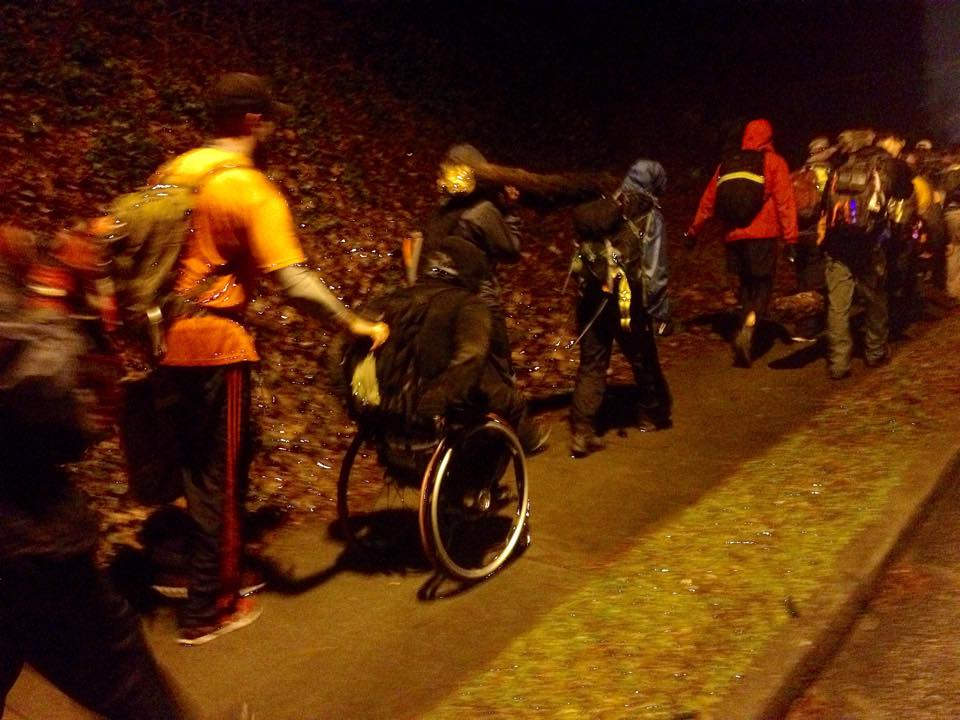
Some of the last of my teammates caught up to me just as I was starting to doubt if I could carry on. They encouraged me on and I got to the final stretch to the finish line about 100 yards behind them.

That last stretch showed me why I will always truly love my fellow athletes. Yes, they cheer for the winner. But there is no describing how they cheer for the newbie who can barely make it.

I was doing all I could to shuffle along, and moving at a pace about equal to an unhurried walk. The pain had to have been visible in my face. As I came past the last screen of trees and the cheers from the sidelines started, I found it in me to move a little faster, and a bit faster yet when I turned the corner into the last straightaway to the finish.

As soon as I was through the timing mats, I had to drop to a knee to regroup. The course official, obviously concerned, walked over, shook my hand and congratulated me on my finish.

It turned out that they had under-estimated how many would finish and were out of medals, but took our info and will send them to us when more are made. The group I had finished with formed up for a finish-line picture.
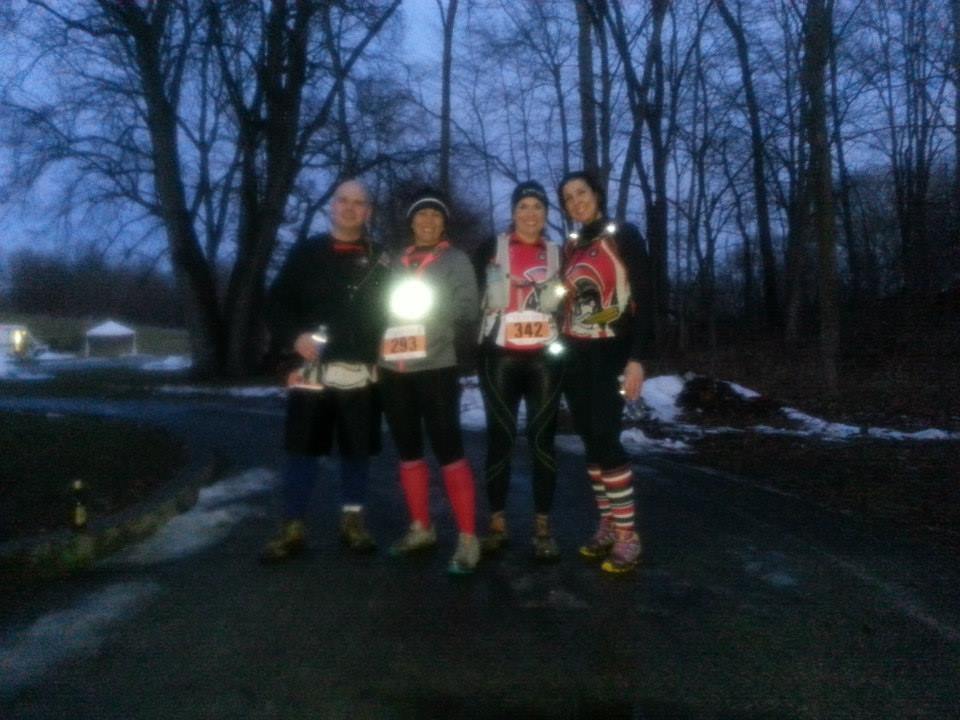
HUFF finish

While not the same type of difficult as a Spartan Beast or a Goruck, it is difficult for me to not call this one of the toughest things I have done. I think one of my teammates summed it up best:

“You know, I was excited about this race. Hated it a lot while doing it. I seriously need a walker for the next couple of days. And…. All my friends and I can talk about is doing it again next year!”

2013 AAR

Time to look back on this year, perform an after action review, and see where to go from here. This blog is nearly a year old. 

2013 was an amazing year. 14 obstacle races, one Goruck Challenge, one Light, two trail races, two road races, five Budo seminars, one Japan trip, and one GR Capstone course. A lot to experience and a lot to learn.

I have always despised New Year’s resolutions. If you want to change something, do it now. Why wait as the problem gets worse to start changing it on some special day on the calendar?

But, it is a convenient date to take stock and make plans. My Sensei asked us for a dojo AAR of three items to maintain and three items to improve. I can think of no better system for this, so I’m using this format.

For 2014-

Maintain:

1) Keep setting difficult goals and knocking them out. I realized some time ago that my 18-year-old self would have to pick his jaw up off the floor if he saw what I am doing now.

2) Keep encouraging others. Both on the course and helping the n00bs get themselves sorted out to make it to the course.

3) Keep attending at least one event a year that is about more than toughness or Budo. 2013 was Navigator. Planning Ascent for 2014.


Improve:

1) Limit long trips to about one a month, and seek out more local events. The time and expense of back-to-back cross-country trips takes a toll.

2) Get my ass out of bed on time and get my morning PT back on track. Evening workouts have been kicking ass, but AM has been more miss than hit.

3) Pay more attention to nutrition. It has more of an impact than I had been willing to admit.


In the Chinese Zodiac, 2013 was the year of the snake, a symbol of new beginnings, shedding the old skin so that the new can grow. I shed my preconceived limits and grew considerably this year.

When I first saw that the coming year is the year of the horse, I chuckled a bit, since my plans for 2014 involve ultramarathons, distances that were originally meant for equestrian races. Then I read more on it and found this:

The spirit of the horse is recognized to be the Chinese people’s ethos – making unremitting efforts to improve themselves.

Exactly what I had planned for the year to come.

To all of my readers, happy new year from the Monk of the Mud.

The Language of Limitations: a response to “Fitness fails: Workouts you need to stop doing in 2014”

I came across an article on the workouts that we all “Need to stop doing.” (http://www.today.com/health/fitness-fails-workouts-you-need-stop-doing-2014-2D11792111) At first I took offense, then I realized that the article was not actually written in English, but in Excusese. Also known as the language of limitations, it is a dialect favored by those who desire a thousand excuses not to step up and try something rather than just one reason that it might be worth checking out.

I only speak the basics of this dialect, but here are segments of the article with my best go at a translation, and a few notes of interest:

Pole dancing. Yes, it takes skill, balance and coordination to spin around a pole upside down. And sure, it’s probably a heck of a workout. But aside from the fact that you’re expected to perform this “sport” in your underwear, pole dancing is risky (in some cases, devastatingly so). Pole dance forums regularly allude to bumps, bruises, cracked ribs and broken toes, says Dr. Ryan Stanton, a Lexington, Ky., emergency room doctors. That’s just the start, says Stanton, who’s also seen back, ankle and wrist injuries. “The majority of injuries are associated with falls,” he says. “And there’s also a risk of skin infections like strep and staph if the pole hasn’t been adequately sterilized.” Eww.

Translation: I don’t care that this is an epic core, grip and upper body workout. It is associated with strippers, and I don’t care enough to research its earlier history, so such things are beneath me. You have to do it in underwear because something that doesn’t sound demeaning (like a gymnastics leotard) is just silly. People who try things beyond their abilities can fall down. No workouts where you could possibly fall down are okay. Oh, and strippers are dirty, so I will think more about infections from this than I will about who used the bench press before me and didn’t wipe off his sweat.

Yoga mash-ups. “Yoga’s not good enough on its own any more,” says Stanton, a spokesperson for the American College of Emergency Physicians or ACEP. “Now you have to turn up the temperature or do it on a paddleboard.” Or do it naked while suspended from the ceiling in a white “anti-gravity” bundle. Aside from being just plain silly, some of these yoga mash-ups can be risky. Stanton says he’s treated people who’ve passed out in hot yoga classes and warns that the practice can be dangerous for people with heart disease. Stand-up paddleboard or SUP yoga also carries a risk — of ending up in a video like this.

Translation: If you are looking for another level of your yoga training, you’re just being silly. If someone with a heart condition can’t do it, why should you take the risk? Oh, and falling down and looking silly is the most dangerous thing EVER. You should never do it, even if this means that you never try anything new.

Monk’s note: I have seen many people do anti-gravity yoga, and some have had great success at rehabilitating injuries that make standard yoga impossible. I have not known anyone who does this naked.

Gas mask training. It’s not just for firefighters and members of the military anymore. Now, regular old gym rats are getting their Darth Vader on by donning specialized — or Army-Navy surplus — gas masks in order to train for high altitude runs/climbs or restrict their oxygen intake for a much tougher workout. While proponents rave about the results (they also readily admit to “seeing stars”), Stanton compares the practice to “being strangled while you’re exercising.” Are you sure you want to run on a treadmill with that thing on, people?

Translation: I do not understand why people would want to use techniques that are uncomfortable. Yes, it can improve your physical abilities, but who cares about that if its uncomfortable?

Monk’s note: I have used resistance mask training. It helped a lot strengthening my lungs (I had pneumonia when I was little and my lungs never fully recovered) and helping me get to where I am. I recommend it highly.

BackwardsrunningAlso known as reverse running, retro running or “gninnur” (Yes, that’s “running” spelled backwards), backwards running may have gotten its start as a rehab exercise for athletes with pulled hamstrings. Today, though, it’s a trend, with races, a world champion and even an attempt to make it an Olympic sport. “That one’s really crazy,” says Jason Karp, an exercise physiologist from San Diego. “Humans are not meant to walk backward. It’s not how we’re designed. My major concern is that you’d trip and fall.” Not to mention strain your neck from looking behind you every three seconds.

Translation: I think it is silly, so you should not do it. Oh, and I think everyone is too stupid to clear their path of obstacles that they might trip over. Remember where I said any workout where you might fall is bad?

Stiletto workouts. Fans of this “fitness” fad say working out in sky-high heels can strengthen your core, improve your balance and give you toned, taut legs. But Neal Pire, an exercise physiologist and fellow of the American College of Sports Medicine, call this fitness craze  dubbed the “the world’s worst workout” by Prevention Magazine — unnatural. “When you wear high heels, you’re shortening your Achilles tendon, throwing off your center of gravity and putting stress on your lower back. And then there’s what happens in your feet.” ER doc Stanton is more blunt: “Anything in stilettos is an ankle injury waiting to happen,” he says.

Translation: I think it is silly, so you should not do it.

Monk’s note: While this one does strike me as odd, to each their own. The injuries listed would be results of over-using this style of workout.

MOB races. “Mud, obstacle and beer” endurance challenges like the Tough Mudder and Warrior Dash have inspired many a couch potato to get off their duff — at least for the weekend. But it doesn’t come without a cost. A study by the ACEP found that a single competition last June resulted in 38 ER visits for everything from chest pain to dislocated shoulders to head and face injuries to electrical burns to paralysis. Even worse, there have been a handful of deaths. “This is a really high risk activity,” says Stanton. “People train for marathons but Tough Mudders attract people who have no intention of training — they just want to get out and run in the mud. It’s risky enough for the person in good shape, much less someone who hasn’t run 3 miles in the last year.”

Translation: I know absolutely nothing about these events. I don’t know that under-trained people show up for marathons or that people do indeed train for obstacle races. I will make up a trendy-sounding acronym for these events, because I refuse to even do a Google search to find a term like “OCR”. Oh, and mention beer to make them look like drunken idiots. I will ignore the idea that this is an actual sport, and thus not compare the injury rates of other sports that result in many more injuries (football, perhaps?). Oh, and I will say this needs to go away and ignore that it is the fastest-growing sport in the world in terms of participation. Remember how I don’t understand why you would want to do anything uncomfortable?

Monk’s note: The author’s obvious lack of knowledge and attempt to discredit obstacle racing particularly irritated me, considering the number of people who have used these events, and training for them, to improve not only the health of their bodies, but the health of their minds and spirits as well.

Stability ball stands. Balance or stability balls have been a fixture at gyms for years. But lately, more and more people aren’t just using them for crunches or stretching, but for hot dog moves like standing atop a ball while doing bicep curls or shoulder presses. Can you say recipe for disaster? “I’ve seen contusions to the sacrum and lower back,” says Stanton. “I’ve seen people hit weight machines, hit benches, hit other people.” Stanton calls the tendency to push the fitness envelope “testosterone syndrome” or the “jock effect.” “People get to a gym and try to do more than they’re capable of,” he says. “But gravity always wins the day.”

Translation: Stupid people can do it wrong and fall down. Thus, no one should do it.

Monk’s note: Above anything else, don’t let articles like this limit your ambitions. Use common sense. Try new things, don’t do things that are way beyond your abilities, and above all have fun. If you love your step-aerobics class, do it. If you are intrigued by races up the side of a mountain, rock-solid holds off a pole, or yoga poses on a surfboard, check them out. Train hard, train smart, build your abilities over time, and go do it!

Don’t let limitations be the language of your life.

What No One Sees

There are things about the challenges and training I do that everyone sees. The photos from the far-flung places I’ve been. My name on the “You did it” board at the gym. The black belt. The stack of finishers medals and T shirts.

But there is so much more that no one sees.

No one sees the man hobbling up a hill on blistered feet, running numbers of the distance left to go and the time left before he will be pulled from the course, and giving all he’s got to hobble just a bit faster. Feeling a blister break open and having to fight to keep from bawling like a child.

No one hears the quiet prayers, half whispered and half cried, begging for just a little more strength. Just another mile. Just another hundred yards.

Another step. One goddamned step.

The pain, the self-doubt. All the times of looking like a fop in front of teachers whose approval matters to you. The re-injuries from some newbie at a seminar who couldn’t remember you were already injured. The countless hours trying to figure out details that everyone else seems to get without a second thought.

But there is another side that no one who has not been through these things will ever see. Mixed in with the pain and disappointment, there are moments of the most extraordinary kindness.

The aide station worker who, with a smile and a kind word, hands you a cup of soup, while the look in her eyes clearly says, “You look like hell.”

The bystanders who cheer the loudest for the poor souls who can barely keep moving.

The training partner who sees you screw up the technique for the thousandth time, but gives you the chance to work on it again and figure it out.

The teacher who will spend an extra 10 minutes working with a white belt, even if they doubt he will ever amount to anything. 

The racer next to you who checks in and offers a word of encouragement as he passes, helps you over a wall, gives up his own finishing time in order to stay with you and make certain you can make it through.

Those who finish a grueling event, and then turn right around to go find teammates who are still on the course.

The further I go into more difficult challenges, the more I see what mankind is capable of. What we will do for each other, what we can be at our best. The darker the situation, the brighter the spark of humanity seems to shine.

A long time ago, one of my teachers told me that the more he trained, the more he was able to become truly human. I think I am finally beginning to see what he was saying.

Take My Advice…

download

I have seen a lot of people struggling with the myriad of contradicting food and exercise advice that seems to flow around us. Carbs make you fat. Carbs fuel your long runs. You need to do everything aerobically. You need to do everything anaerobically. Only use body-weight exercises. Only use free weights. No, only use machines. Stop running and lift. Stop lifting and run. No, follow my plan, for which you will pay me three easy payments of $29.95!

In too many cases, they get so confused about what to do, that they simply stay where they are and do nothing. Paralysis by analysis.

Its even worse for newbie athletes, as 90% of the advice is based on the assumptions that you need to lose weight, you mainly care about your appearance, and you don’t really care about what you can DO. I turned off one workout-advice video when it got to, “Why would you do this? You don’t really need to be strong here, and this won’t help your 6-pack, here, do this instead!”

How to get through all of this without losing your mind: Don’t over-think it, and just do something. Or, as a friend put it more bluntly, “Quit mind-f***ing it!!!”

You know where you stand now and what abilities you want to improve. Pick a program. Whatever one looks good to you. Stick with it for a minimum of 8 weeks.

OK, 8 weeks down. What worked, what didn’t? Learn from that, learn what works for you. Don’t be surprised if you go back to it when nothing else seems to be working.

Is there something else that you want to focus on?

Pick another program, for at least another 8 weeks. Rinse and repeat.

“But I can’t find a program that covers everything I need!” Neither can I. But if i cycle through 3 programs that each hit at least half of what I’m working on, I have more than covered everything over the course of 24-48 weeks, shifting off as I get through each program. I have found it much more effective to cycle through adequate programs, rather than spending all my training time searching for the one perfect system that has it all.

“Why not change it up every day, rather than 8+ weeks at a time?” Your choice, there are many who shake things up every day. But I appear to be a slow learner, and it takes me about a week to learn a new program (and all the movements it involves) and run with it. It is easier to sort out what is and is not working when you have several weeks worth of changes to look at.

Above all else, do SOMETHING. Don’t fuss too much over making certain that it is exactly the best thing in the world, as long as it is moving you forward.

“In any moment of decision, the best thing you can do is the right thing, the next best thing is the wrong thing, and the worst thing you can do is nothing.”

Theodore Roosevelt

Honorable Mention: Rugged Maniac Southern Indiana and Savage Race Texas

There have been a few races recently that deserve a write-up, but I have struggled with how to go about it.

In my mind, all of the OCR world forms a spectrum from the fun, relatively easy mud runs to the horrendously tough, soul-stomping challenges that teach you what you are made of.

The events that rip out your soul and beat it with a sledge hammer- those are easy to do a write up of. What I conquered, what I got mangled by, what I learned, all at the front of my mind.

The other end of the spectrum: Fun as all get-out, some difficulty, but often hard to find a focus as to what it developed in me, what deserves to be said, etc. With that said, here is the story of two such races.

Rugged Maniac

Held at a ski resort with reasonably hilly terrain, atmosphere of the other athletes was good, obstacles were fun but not all that noteworthy. The water slide is the only one that really stands out from most other races.

One of the athletes was a young man who had lifted a lot of weights, but admitted he had never run more than a mile. I slowed my pace to match him and encouraged him on, and we both got through it.

The other standout memory was not actually part of the race, but the mechanical bull in the festival area.


Savage Race

Let me start with my one criticism of this race, because I really did like this one and I want to get this out of the way: $25 each for race photos. Really. And you only managed to get one. I see.

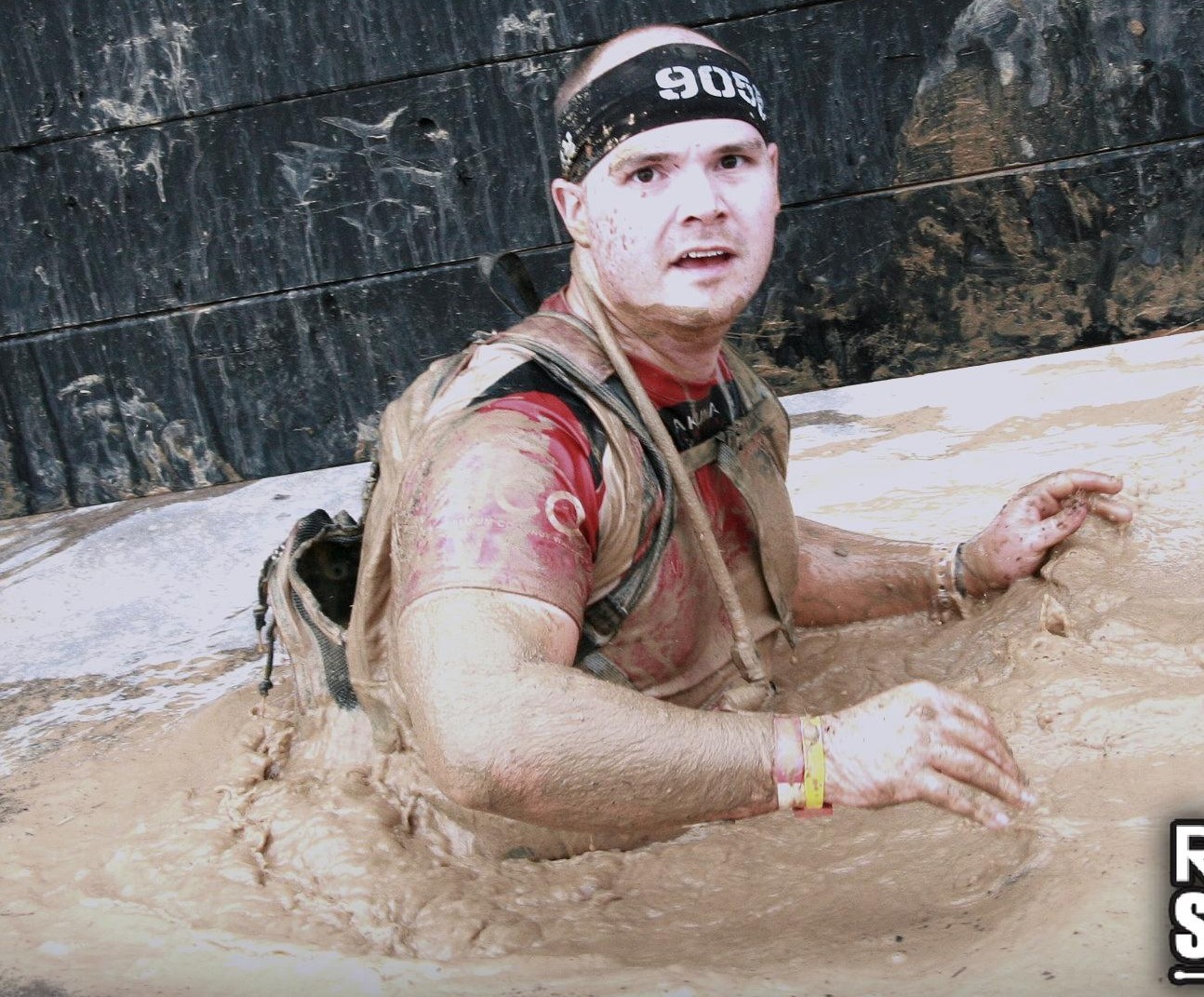
So, all the readers must take me at my word that I made this look GOOD… Photos here stolen from Savage Race’s Facebook page.

I had assumed that the Southlands in November would be a safe bet for weather, but the weather turned just a few days before the race and it was cold, wet and nasty, and the rain kicked up just as we were entering the starting corrals.

I did something I almost never do: I skipped the first obstacle. It was an ice bath, I was unsure of doing it at the very start of a 10K, so I went around it. Doing it again, I would have done the obstacle, the cold passed quickly as I got moving. It didn’t matter much, as the next obstacle had me on my back in cold water less than 100 yards later.

A lot of obstacles were familiar with modifications. The slip wall with a shorter rope, so you either need a running start to grab the rope or have a teammate boost you up. Running up a halfpipe to grab a rope that you must climb vertically from that point on.

Their signature Sawtooth monkey bars were situated after so much slick mud that very few people made it across. Although in fairness the weather is more to blame for that than the race director.

The upside down cargo net over a slip-n-slide was cool, and gave me a lot of ideas for home training. Lie on your back and pull yourself up under the cargo net.

The last obstacle was the electrified low crawl. Myself and the three I had teamed up with along the course got on line just in front of the wires, someone said GO and we all charged in. I got tagged at the back of the skull and it slammed my face solidly into the ground, all the other shocks I got going through were minor.


All in all these were both REALLY fun races, and I do recommend them. They are much more like Warrior Dash in the sense that it is a good time with some challenge involved, rather than the other races that are an epic challenge that happens to be fun for us crazies.

Why do we do this to ourselves?

It was pointed out to me that everything I do with my personal time, viewed from the outside, doesn’t look like very much fun. In fact, it looks like it hurts. And looking at some of the photos, I can’t help but agree.

12

I often get the question of why. Why do you want to go do uncomfortable things? Why do you need the ability to clear an 8′ wall, to low-crawl under barbed wire? You have a car, what point is there in running 20 miles?

I often have difficulty answering these questions. I usually avoid answering by saying that if you have to ask, you are unlikely to understand the answer. But it is a legitimate question, and deserves at least an attempt at an answer.

I had my first trip to Japan earlier this year to train with the top Shihan. At the end of one of Nagato Sensei’s classes, he asked if there were any questions. Some smartass in the crowd yells out, “What does it all mean?”

Nagato has the question clarified in several languages, then gives the response, “The purpose of training is to be a good person. An exemplary person.”

For blog

I do feel that in many ways the training and challenges I do have made me a better person. The Japanese would call the process “polishing the spirit.”

I have also developed a deep love for those around me, whereas a few years ago I was unable to feel anything but disdain. And I can step up to challenges that I previously would have thought were impossible.

I also love seeing what the human spirit is capable of, both what I can do through sheer force of will and what I see done by others. Even those who have a better excuse than most to think that it is impossible.

for blog 2

310377163_10203172823673342_3231246887656132219_n

I want to know what I’m made of, what I can do, and what I can do under adverse circumstances. This is where people have the most trouble understanding me. Why does it have to be cold, wet and nasty? Why can’t all the obstacles be made of bubble wrap so that no one ever gets a bruise? Oh, that obstacle is severely uncomfortable and that makes it physiologically unsafe, they should eliminate that one.

These things build toughness and they train courage. They teach you to keep going through the pain and do what needs done. If you can’t perform when you are cold, wet, in pain, then I would argue that you can’t perform. When things go to crap and you NEED your toughness and courage, trust me, you will be rather uncomfortable and likely in a certain degree of pain. If you have trained to embrace the suck and keep going, you will be fine. Otherwise, you may well be in trouble.

In particular the electrified obstacles take a lot of flack for being over the line, too uncomfortable and intense, too dangerous. I’m not going to weigh in on that debate, simply because it varies too much from race to race, but I will tell the following:

I was at a race a few weeks ago and teamed up with a group of young men doing their first mud run. One of them was severely freaked out at the prospect of the electrical obstacles. Every wire crawl we passed, he was worriedly saying, “Is that the taser obstacle??!!”

When we finally got to it, there was a short wire crawl before we reached the shock wires, and the course volunteer suggested that the individual shocks would be less intense if more than one person went through at a time, so we got all four of us lined up just in front of the shock wires and then charged forward as fast as we could, going even faster after the first jolt.

We stopped to fist-bump and check on each other, and the fear that I had sensed in him was gone. He had gone up against his fear and kicked its ass.

I had only met the man on the course, only knew his first name, but seeing that change come over him was the highlight of the day. That’s the prize at the end of the struggle. That’s what we go through this for.

Dead Last, DNF, and What If.

81FfGxAS5DL._SX466_

I ran a local Thanksgiving 15K today, and experienced something that I have never had happen before.

I finished last.

Mind you, not last in my division, not at the back of the pack as we all storm the finish line, but DEAD last, not seeing another soul for the last mile, stopping to ask a policeman what direction to the finish line, crossing under the inflatable finish arch as the course volunteers are prepping to take it down.

My feelings on this fact: HELL YEAH.

I beat the goal time that I had set for myself by 7 minutes.

The fact that I was completely and utterly outclassed by the others on the course? That simply means that all the others of my ability or below stayed home or did a shorter distance.

A lot of newbie runners that I talk to are terrified of coming in last or not being able to complete the course, and limit the events they sign up for to what they KNOW they can handle. All they can see is the, in their eyes, public humiliation of being the worst athlete.

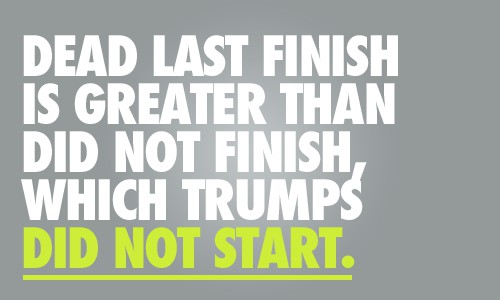
News for them: The worst athlete never made it to the course.

did-not-start

Something less than 5% of the US population will run a half-marathon. That falls to 1% for the full marathon. So really, merely lacing up your shoes and stepping into the starting corral puts you at least in the top 10%.

Cross the finish line last? Take pride in knowing that there are thousands of people, with physical abilities equal to yours, that lack the nerve to sign up, step up, and do what you just did.

Failed to make it to the finish line? As H.W. McBride said many years ago, no man is ready to go through a battle until he HAS been through one. Learn from what worked, what didn’t, and come back to hit it twice as hard.

When my time comes and I look back on my life, I will be completely happy with, “I wasn’t the fastest or the strongest, but I got it done.” I will even be able to make peace with, “Failed every damn time, but I gave it all I had.” The one thought that will never sit right is, “I wonder if I could have, if I’d had the nerve to try.”

Go. Embrace the awesome within you and see how far you can take it. Find events that you are not sure you can handle, and go knock them out. Don’t fear failure. We only fall so that we can rise again stronger.

And when you find the scary epic events to go after…Call me. I likely will want to come too.

Bunny Beast Mode- Carolinas Spartan Beast 2013

This was my third Spartan Beast of the year, and the first that I felt truly prepared for. Overall I am finally feeling improvement in my abilities. I have found that all Beasts will plan something evil for you within the first half mile, something that will start sapping your fighting spirit. On the past two it was a brutal uphill, but they were more creative on this one. Less than 500 yards in and we are sent through trenches of cold water, instantly locking up my calves and making it hard to do anything past a walk. From there it was the familiar Spartan obstacles, 6-7 walls, trails that were technical but not anywhere near the soul-crushing hills I had come to expect. We hit the Atlas Lift, and the course volunteer’s eyebrows raised a bit when he saw me cranking out full clapping burpees. I’ve gotten sloppy on my burpees with a few recent races, and am really trying to break the habit.

More trails and we came to the Hercules Hoist, which is where the fact that I am getting better seemed to crystallize. I usually drop body weight, climb the rope with my hands as I stand back up, and repeat. This time it just came together, I dropped my body and was able to keep the smooth upward motion going with hands only. It must have looked good, because I heard the stunned voice of the course volunteer behind me go, “Damn. BEAST MODE! Hell yeah!” Back on the trails, Tarzan-swinging and butt-scooting down steep hills, and came to the tractor pull. For once I felt strong enough to move at a trot with the weight, and I actually saw the photographer in time to set up the shot. Most races have the standard tire flip. This one upped the ante by giving us a 4′ section of log to flip end-over end. Note to self: put more deadlifts in your workouts. No burpees but still tough. Next was the tire drag, which I knocked out solidly enough to again get cheers from bystanders. New and rather odd, but I think I like it.

About this time Princess Badass (one of my teammates) and I noticed that she was passing me nearly every section of trail running, and I was overtaking her at nearly every obstacle. She commented, “You are like the Energizer bunny. You just never seem to stop.” Beast Mode Bunny?

Somewhere around the traverse wall and spear throw my commitment to burpee form fell through, and I think I walked away from the spear throw at 20 rather than 30. I told myself that I am freaking better than this and did 40 at the rope climb, then donated an additional 10 to a teammate before heading on. Next was one of the most horrendous mud pits I have ever been through, coating my hands with enough slick mud that the monkey bars were not a possibility. The terrain from that point got noticeably tougher, which was good as a few of us were starting to refer to the course as “the Bitch Beast.” I elected to do burpees rather than wait for the line at the rope traverse, then moved on to the sandbag carry.I was a little shocked to actually see sandbags abandoned along the course, where people had gotten a certain distance and then given up. Putting the sandbags right after a water obstacle meant that most of the bags were wet and thus heavier than normal, but still got through it and handed the bag off to the next runner. I was a little surprised to see the Hobie Hop as an obstacle here, as the stadium Sprint was the only place I had seen this before. I waddled more than I hopped.

I had been forced to skip the bucket carry in Vermont to meet the time hack, so I was happy to get a chance at it here. The course volunteer directed us to take buckets from those coming back down the hill rather than dumping and refilling, and I got one that was a little under the required level. I ended up taking a rest break next to a female racer whose bucket was a little overfilled, so I used some of her gravel to bring mine up to snuff.

We then hit the barbed wire crawl that was reported to be one of the toughest. While it did suck that it was through a gravel pit (torn up knees that are still healing), it did not have the rockiness of Vermont or the slick steep inclines of Nebraska, so I found it tough but not nearly what I expected from rumors of it. From there it was the standard end-of-race obstacles, the cargo net, dunk pool, and slip wall. For whatever reason, there were a LOT of people suffering from cramping on this race. The man in front of me went into a rather spectacular leg cramp 3 steps up the ladder to the cargo net. I helped him down  and then went on my way.

The dunk pool  had a small gap between the water and the wall I had to go under, so I had a much easier time than at any of the previous races with this obstacle.

Then over the slick wall, over the fire, and through some impeccably dressed gladiators.

I finished in 5:16, more than 2 hours ahead of my finish time at Ottawa. While some of that may be improvements in my abilities, I have no doubt that a large part was the terrain. While it was a tough race, it was nowhere near the brutality of the Mountain Series races. Anyone wanting to go for a Trifecta but not quite sure you can handle a Beast, this is the one I would recommend to you.

Beyond Expectations: Miller Park Spartan Sprint, 2013

I had heard of the “Stadium Sprints” put on by Spartan Race, but the idea had never really appealed to me. I love the single track woods trails, the natural obstacles. I’m not a ball-sport person. I honestly had to ask what Miller Park was, so the draw so many people talk about of a famous location held no appeal to me. 

I started dating a fellow mud warrior, and she mentioned that she wanted to run this race, but was unsure if she could get there after attending a wedding the night before. OK, you need a driver and battle buddy. I can do that. So I signed up to run it with her.

Wow was I wrong about the stadium sprints. A different category of challenge from field Sprints, not more or less challenging but different, more like a weightlifting class than a run.

We had a team of more than 300 in attendance. 

These sprints release groups of about 15 people every few minutes to avoid bottlenecks on the course, as it is restricted and there is little room for passing. We started out running up ramps to the upper levels of the stadium, with ropes tied across that we had to go over or under. I found that if I got low and extended one hand forward, I could run under the ropes like a cartoon ninja and not be slowed down.

We then came to the familiar obstacles, 6′ walls and lots of stairs.

Then we hit the more unusual events. Medicine ball slams. Hand-release pushups. Wait, rowing machines?

You had a certain time to cover 500 m. No time shown on the display, when you reached the goal or ran out of time it would simply say “Congratulations. ARROO!!” or “Burpees for you!!” Several of our team were literally on the floor unable to rise for a few minutes after this obstacle.

Most things were pretty basic, carry heavy object, go up and down bleachers, etc. The jump rope with a 2″ rope was unexpected and much tougher than it looked. I couldn’t get more than 5 in a row, and several people injured their ankles at this point.

Some of the team donated reps to get the rest of us through, formed burpee teams to assist those that failed obstacles, and otherwise encouraged us all.

There were a few places where the race went out into the parking lot with the more familiar obstacles, jerry can carry, atlas lift, traverse wall. My girlfriend/battle buddy spotted me as I went across the traverse wall. The last step was too wide to clear, but I was able to stretch enough from the previous step to ring the bell, then went back and spotted her, and we both made it.

The last section of the race had several obstacles scattered around the baseball diamond, the first being the cargo net, where most of us ended up on the jumbotrons.

We nailed the Hercules hoist, both burpeed out of the rope climb, and went to the final obstacle, 10 over-and-back box jumps, then charged through the gladiators.

We received our special-edition medals and joined our teammates in the bleachers watching the rest of the team finish.

Typically, I am the personification of “I come. I tear it up. I leave.” For once I took the time to hang out with teammates, chat with the families of other competitors, hit up the after party, etc. Somewhere along the line I’ve gained a team off the course as well.